TDLR: Swami Sri Yukteswar says that the Golden Age, or “Satya Yuga” was between 16,300 and 6701 BCE. Let’s look at what the evidence says happened during this time period, in India and around the world.
What does Yogananda and Sri Yukteswar say?
In Swami Sri Yukteswar’s The Holy Science, Sri Yukteswar describes his interpretation of the Indian concept of the Yugas, or repeating, themed cycles of time governing all of human history. In this post I will only be discussing the concept of a past “Golden Age”. If you’d like to read about his full theory, it is located in the introduction to The Holy Science.
According to Sri Yukteswar, the last “Satya Yuga” was between 16,300 and 6701 BCE, a period of 4,800 years on either side of 11,501 BCE, which he says was the highest point in the cycle (combine the ascending and descending Satya Yugas to make a period of 9,600 years).
During this time period, Sri Yukteswar says that “dharma, the mental virtue becomes so much developed that man can easily comprehend all, even the mysteries of Spirit”.
What the archaeological evidence says happened between 16,300 BCE and 6701 BCE
This time period pre-dates writing, so for this time period we can learn from archeology – what do the artifacts and man-made structures of this period tell us?
At the beginning of this time period, we find the first evidence of pottery, settlement, and plant gathering. We begin to see the transition from hunter-gatherer cultures to settled cultures, with the first instances of potters, animal herding, and plant-collecting, with agriculture developing in some locations at the very end of this time period.
Middle East – Natufian Culture – First houses, Pre-agriculture Settlement, Plant gathering (15,000–11,500 BCE) (https://en.wikipedia.org/wiki/Natufian_culture)
Japan – Incipient Jomon Period – First Pottery, Settlement (from 14,000 BCE to 300 BCE). The earliest pottery was plain, followed by pottery with nail impressions, ridge patterned, or cord impressions. (https://jomon-japan.jp/en/learn/jomon-culture)
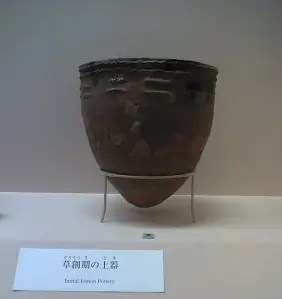
Incipient Jomon Pot (10,000-8,000 BCE), Tokyo National Museum. These pots were placed directly into fire pits for cooking. (https://heritageofjapan.wordpress.com/just-what-was-so-amazing-about-jomon-japan/ways-of-the-jomon-world-2/jomon-crafts-and-what-they-were-for/ways-of-the-jomon-world/types-of-pottery-and-how-to-make-a-jomon-pot/)
India – Late Paleolithic and Neolithic cultures. Transition from hunter-gatherers with stone tools to settled culture. Cave paintings from 10,000 BCE.
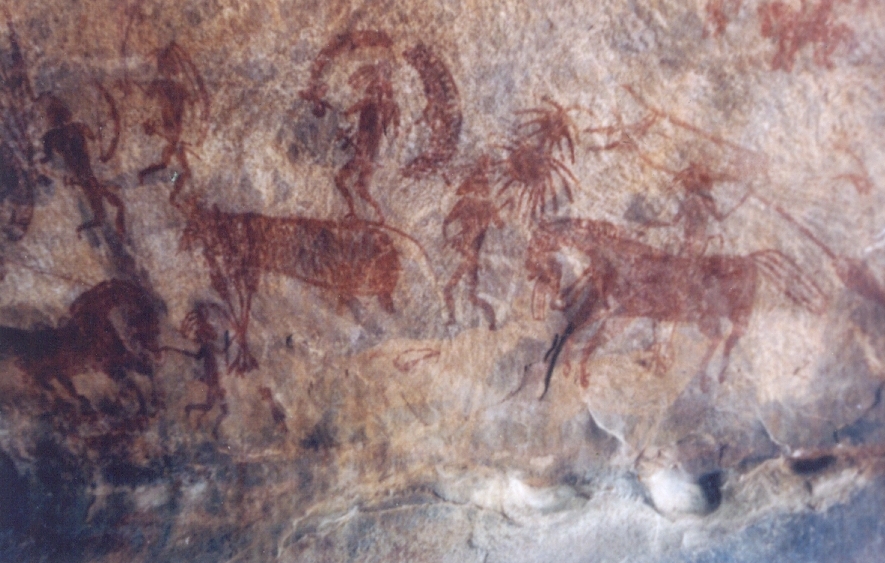
Early cave painting at Bhimbetka showing dance, animals, and hunting. Later Bronze Age paintings on the same wall show warriors on horseback. Some geometric figures are dated to the medieval period. https://en.wikipedia.org/wiki/Bhimbetka_rock_shelters
Europe – Karahan and Gobekli Tepe – 10,000 BCE – 8,000 BCE – Pre-agricultural settlements with animal sculptures, large human face carvings, anatomically correct male statues. (https://en.wikipedia.org/wiki/Karahan_Tepe, https://en.wikipedia.org/wiki/G%C3%B6bekli_Tepe)
End of the Ice Age – 8000 BCE
Americas – Las Vegas Culture – 8000 BCE
Middle East – 8000 BCE – Tower of Jericho (first tower)
Pakistan – Mehrgarh – 7000 BCE – Beginnings of a small, pre-pottery farming village that domesticated wheat and herded sheep, goats, and cattle. https://www.thoughtco.com/mehrgarh-pakistan-life-indus-valley-171796
Conclusion
Because this period pre-dates writing, it’s difficult to determine whether the people at this time were able to “fully comprehend Spirit” and dharma. There’s no evidence of a concept of Dharma or comparable philosophy, and the Vedic culture had not yet begun in India.
Note about SRF’s public statements about “Golden Age”:
I would like to add that whenever Brother Chidananda or other SRF monastics mention “India’s Golden Age” or a past “Satya Yuga”, they never mention the time period given by Sri Yukteswar (between 16,300 BCE and 6701 BCE). Have they been instructed to be vague so no one gets the impulse to fact check them, or have they just never thought deeply about it themselves?
Sources:
- The Holy Science, Swami Sri Yukteswar, 1990, Self-Realization Fellowship
- https://www.thoughtco.com/mehrgarh-pakistan-life-indus-valley-171796
- https://en.wikipedia.org/wiki/Karahan_Tepe,
- https://en.wikipedia.org/wiki/G%C3%B6bekli_Tepe
- https://en.wikipedia.org/wiki/Bhimbetka_rock_shelters
- https://heritageofjapan.wordpress.com/just-what-was-so-amazing-about-jomon-japan/ways-of-the-jomon-world-2/jomon-crafts-and-what-they-were-for/ways-of-the-jomon-world/types-of-pottery-and-how-to-make-a-jomon-pot/
- https://jomon-japan.jp/en/learn/jomon-culture
- https://en.wikipedia.org/wiki/Natufian_culture
Leave a Reply